

James
April 23, 2025
The web development landscape in 2025 is buzzing with innovation—AI-driven tools and hyper-personalization are reshaping how businesses build their online presence. As a business leader, you might be wondering: should you opt for an out-of-the-box solution like Wix, Squarespace, or WordPress, or invest in a custom website? At JamoTech, we specialize in custom app development and tech consulting, and we’ve seen both approaches in action. Here’s a clear guide to help you decide, grounded in the latest trends and practical insights.
AI is no longer a buzzword—it’s a core part of web solutions. Platforms like Wix, Squarespace, and WordPress now offer adaptive content personalization, using AI to tailor user experiences in real-time based on visitor behavior. Wix’s ADI crafts sites from user inputs, Squarespace enhances layouts with design intelligence, and WordPress leverages plugins like Jetpack for AI-driven insights. This aligns with the broader trend of hyper-personalization, where websites dynamically adjust to individual users to boost engagement and conversions. On the custom side, headless architectures are gaining traction, allowing businesses to decouple their frontends and backends for greater flexibility. This approach, often paired with AI integrations, powers composable commerce systems—think modular, scalable eCommerce experiences that adapt to unique business needs. Both out-of-the-box tools and custom solutions aim to enhance user experiences, but they differ in how they get there.
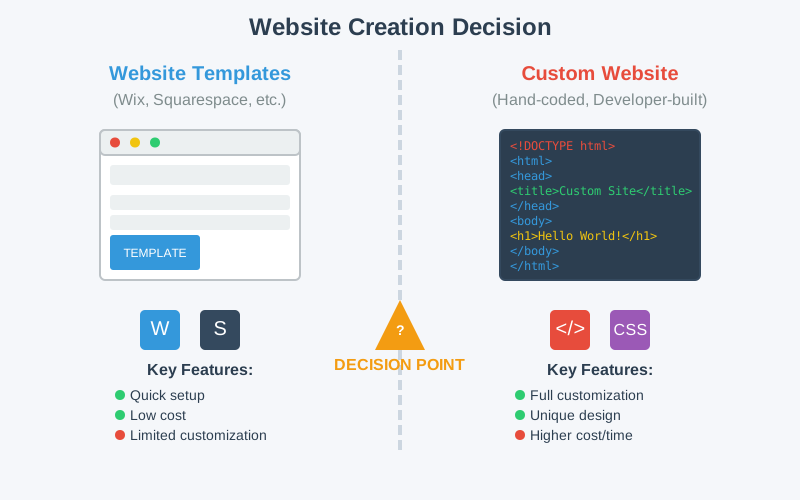
Out-of-the-box tools like Wix, Squarespace, and WordPress shine for businesses that need to move fast and have straightforward needs. If you’re a small business, a startup, or launching a minimal viable product (MVP)—a concept we’ve explored in our article Why Your MVP Isn’t ‘Minimal’—And How to Fix It—these platforms are strong contenders. Wix offers AI-driven design with Wix ADI, Squarespace provides stunning templates with built-in personalization, and WordPress delivers flexibility through its vast plugin ecosystem. Built-in CMS features also simplify content management, much like we use Sanity CMS for our blog, making it easy to update pages without technical know-how. Plus, their hyper-personalization features can help you engage users without a big upfront investment.
However, these tools have notable limitations: their templates can lead to a 'cookie-cutter' look, making it hard to stand out in a crowded market. Wix may lock you into its ecosystem, Squarespace’s customization is constrained by its framework, and WordPress can become complex with plugin bloat. While the initial setup is quick, subscription fees can add up, and you might face extra costs for premium features. For businesses that require unique workflows or complex integrations, out-of-the-box tools may not be the best long-term solution.
Custom websites offer unparalleled flexibility and uniqueness, making them ideal for businesses with specific needs or long-term growth goals. With a custom solution, you’re not bound by template restrictions, allowing for a design that truly reflects your brand’s identity—crucial in a market where differentiation is key. For example, a headless architecture lets you build a modular site that scales seamlessly, integrating AI for personalized experiences that go beyond what out-of-the-box tools can offer.
While the upfront cost is higher, you avoid ongoing subscription fees and have full control over your site’s functionality. This means you can integrate any third-party tools or features as your business grows, without being constrained by platform limitations. As we’ve noted in The Hidden Costs of Over-Engineering Frontend Applications, overdoing it can be costly—so start with an MVP, even in a custom setup, to test your ideas before scaling.
Choosing between out-of-the-box tools and a custom website comes down to your priorities. Here’s a quick checklist:
For example, a small eCommerce store might use Squarespace to launch quickly and leverage its AI personalization. But a startup with unique features and integrations, benefits more from a custom build. Either way, start with an MVP to test your idea—whether on an out-of-the-box platform or a custom framework—before going all-in.
In 2025, both out-of-the-box tools—Wix, Squarespace, WordPress—and custom websites offer powerful ways to harness AI and hyper-personalization, but the right choice depends on your business goals. Out-of-the-box tools are ideal for speed and simplicity, delivering a solid basic web presence, while custom solutions provide the flexibility to scale and innovate. Not sure which path is right for you? Reach out to us at JamoTech for a consultation—we’ll help you align your web strategy with your growth plans.
© 2026. All Rights Reserved.